A homeowner selects absolute black granite for a kitchen island, and the installer hangs 2700K pendants because that is what was in the truck. The slab becomes a dim void where knife work is unsafe, the stone looks brown, and the callback costs more than the fixtures. For kitchen pendant lighting installed over dark stone counters such as absolute black granite, soapstone, or dark quartzite, 3000K is the baseline correlated color temperature (CCT). A 3000K LED module provides sufficient lumen output to overcome low surface reflectance while maintaining accurate color rendering for food preparation tasks in residential kitchens. See also: cabinet color lighting requirements.
Contents
- What is the best color temperature for kitchen pendant lighting over dark stone?
- Why does dark stone absorb more light than white quartz countertops?
- How does correlated color temperature shift the appearance of dark stone?
- Why do CRI and R9 values matter more than CCT for kitchen island hanging lights?
- Which CCT and specification combinations work for pendant light fixtures for kitchen island layouts?
- How do you verify color temperature before installing kitchen pendant lighting?
Key takeaways
- Absolute black granite and soapstone absorb a significant portion of incident light rather than reflecting it into the room.
- Dark natural stones like absolute black granite and dark quartzite have a Light Reflectance Value (LRV) below 15 percent, absorbing up to 85 percent of incident light.
- Correlated color temperature directly alters the perceived hue of dark stone countertops under kitchen pendant lighting.
- A high Correlated Color Temperature cannot compensate for poor color rendering.
- This comparison table matches specific dark stone materials with the optimal CCT, minimum CRI, and R9 targets for pendant light fixtures for kitchen island installations.
What is the best color temperature for kitchen pendant lighting over dark stone?
Absolute black granite and soapstone absorb a significant portion of incident light rather than reflecting it into the room. Standard white quartz reflects roughly 60 to 75 percent of visible light back toward the viewer, giving pendant fixtures an easy surface to work with. Dark stone slabs return only 5 to 15 percent of that same light. As a result, a 2700K bulb, which casts heavy amber wavelengths, turns a black island into a dim void where knife work becomes unsafe. A 4000K source pushes too far toward the blue spectrum, flattening the natural depth of the mineral and making the stone look like poured concrete. The 3000K midpoint delivers enough short-wavelength energy to define edges and textures without bleaching out the material character.
Residential kitchen islands need adequate task illuminance at the counter plane. General practice targets between 30 and 50 foot-candles on horizontal work surfaces where cutting and plating occur. Reaching those levels over dark quartzite demands more delivered lumens from the pendant fixture itself because the slab will not contribute ambient bounce light to the surrounding cabinetry. Specifying 3000K modules rated for high lumen output lets installers meet task requirements without adding excessive fixture count above the island.
Surface condition affects how much of that 3000K light actually reaches the eye. Before testing any lighting layout, the slab must be clean and free of residue. The Natural Stone Institute recommends cleaning natural stone surfaces with neutral cleaners, stone soap, or mild liquid dishwashing detergent and warm water for routine maintenance planning across residential floors, walls, and counters. Soap film left behind by improper cleaning creates a milky layer that scatters light unpredictably, changing perceived brightness during mock-ups.
Scratches introduce another variable that distorts reflectance readings. The Natural Stone Institute warns that scouring powders or creams can scratch natural stone surfaces because those products contain abrasives. Micro-scratches across a honed soapstone finish diffuse light in random directions, reducing the specular reflection that gives dark stone its visual weight under pendant fixtures. A scratched slab tested under temporary construction lighting often leads designers to specify higher wattage or cooler color temperatures to compensate for damage that should have been prevented.
Selecting 3000K solves the spectral balance problem, but a gap remains between the light leaving the fixture and the light returning from the counter. Understanding why dark stone absorbs more light than white quartz countertops explains exactly how many additional lumens the specification requires.
Why does dark stone absorb more light than white quartz countertops?
Dark natural stones like absolute black granite and dark quartzite have a Light Reflectance Value (LRV) below 15 percent, absorbing up to 85 percent of incident light. White engineered quartz reflects 70 to 80 percent. That absorption deficit requires higher delivered lumens at the work plane to maintain task visibility.
Absolute black granite typically registers an LRV between 3 and 6 percent. Soapstone falls in the 8 to 14 percent range depending on mineral density and oil treatment. Dark quartzite varies from 10 to 15 percent. Standard white engineered quartz consistently returns 70 to 80 percent of visible light to the room. IES RP-28 recommends 30 to 50 foot-candles for kitchen island task planes where food preparation occurs. Reaching that target over an LRV of 5 demands roughly four times the delivered lumen output compared to an LRV of 75. Installers who specify pendant lighting for kitchen island layouts using white-quartz lumen calculations will leave dark stone work surfaces underlit.
Stone reflectance is separate from the effect of surrounding cabinetry. The cabinet color lighting requirements for a kitchen dictate ambient bounce light, but horizontal slab absorption governs direct task illumination. A white cabinet run cannot compensate for a black granite island top that absorbs light before it reaches the cutting board.
Specifying higher-output LED modules for low-LRV stone avoids the energy penalty that once made bright kitchens expensive to operate. ENERGY STAR states that qualified LED lighting uses at least 75 percent less energy and lasts up to 25 times longer than incandescent lighting. That efficiency margin lets contractors select high-lumen LED arrays capable of delivering 50 foot-candles to dark quartzite without exceeding residential circuit limits or inflating operating costs.
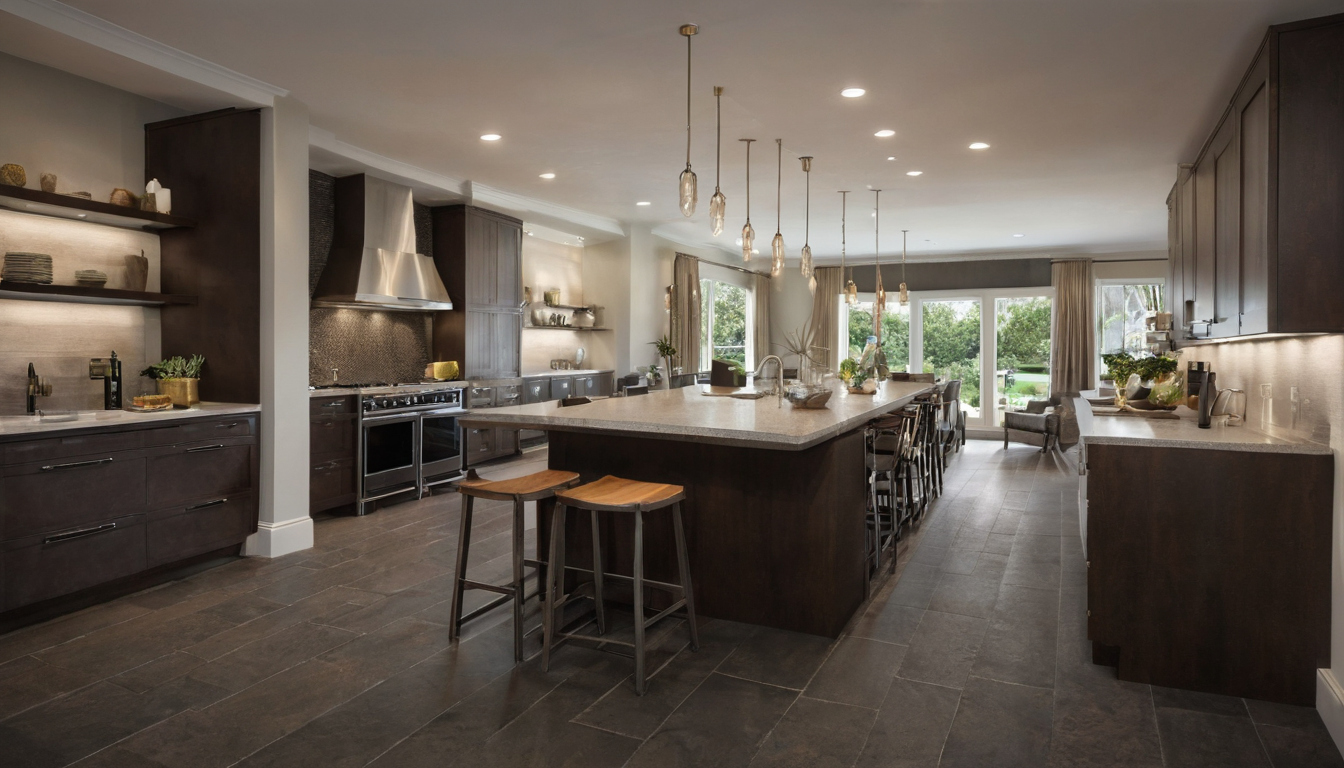
Why does dark stone absorb more light than white quartz countertops.
Honed soapstone and honed dark quartzite scatter incoming light across a wide diffusion pattern. The matte texture breaks the specular peak into thousands of micro-reflections. Total light absorption remains governed by the base LRV, but the scattered distribution reduces perceived brightness at any single viewing angle. A honed black granite surface might register the same foot-candle measurement on a meter held flat against it, yet appear visually darker to someone standing three feet away preparing a meal.
Pendant light fixtures for kitchen island installations must account for this difference. Polished dark stone paired with narrow-beam pendants produces harsh glare hotspots that obscure knife work. Honed dark stone paired with the same narrow optics looks flat and starved of contrast. Wide-beam diffusers soften glare on polished slabs while flooding honed surfaces with enough scattered photons to lift the perceived brightness back toward usable levels. Testing both finishes under identical lumen loads reveals that surface texture shifts the required beam angle more than the total wattage.
Higher delivered lumens address the visibility gap between dark stone and white quartz, but lumen volume alone does not control spectral quality or the perceived color of the slab under those lights. Understanding why dark stone absorbs more light leads to the next variable: how does correlated color temperature shift the appearance of dark stone?
How does correlated color temperature shift the appearance of dark stone?
Correlated color temperature directly alters the perceived hue of dark stone countertops under kitchen pendant lighting. A 2700K source emphasizes warm undertones in soapstone, making it appear brownish, while a 4000K source can introduce an unnatural blue-gray cast to black granite. Testing under actual fixture conditions prevents costly mismatches.
Spectral power distribution determines how much energy an LED module emits at each wavelength. A 2700K LED concentrates output heavily in the red and amber spectrum, amplifying any iron oxide or warm mineral veining present in dark quartzite. Soapstone slabs carry natural green and gray variations that shift toward muddy brown under this heavy red bias. Absolute black granite reflects so little total light that the fixture’s dominant wavelengths dictate the only visible surface color the human eye registers.
A 3000K CCT balances red and blue spectral output more evenly across the visible range. This balance preserves the intended depth of dark stone without forcing a warm tint onto cool minerals. Installers who select 3000K for kitchen island hanging lights over low-reflectance surfaces typically avoid the color distortion callbacks that plague 2700K installations on identical slabs.
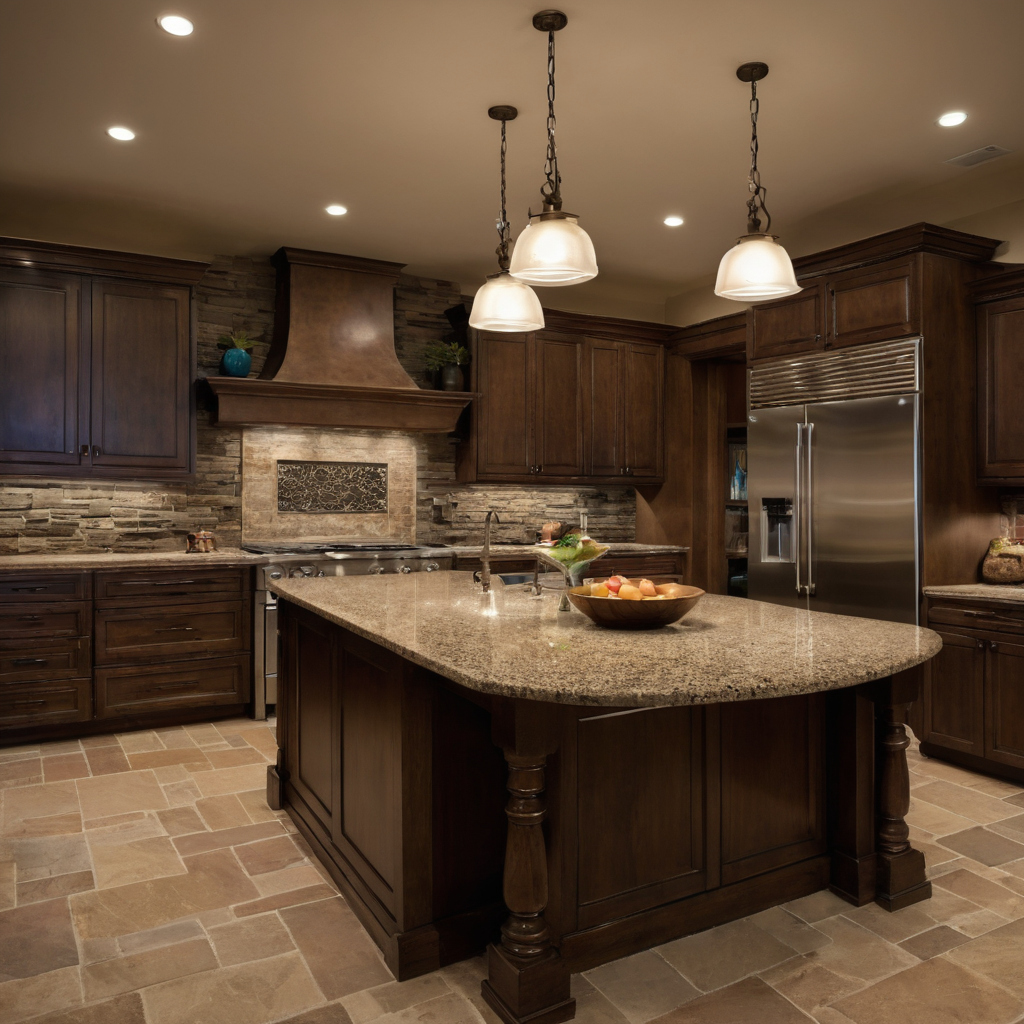
How does correlated color temperature shift the appearance of dark stone.
Higher color temperatures like 3500K and 4000K push spectral energy toward shorter blue wavelengths. Over white quartz, this blue shift reads as crisp and modern. Over absolute black granite or honed soapstone, the same 4000K output flattens visual depth and gives the slab a cold, industrial wash. The stone loses its natural character because the short-wavelength dominance overrides the subtle mineral colors embedded in the matrix.
Pendant light fixtures for kitchen island layouts must deliver the correct spectral mix, not just sufficient lumen volume. A high-output 4000K fixture will illuminate a dark counter but distort the material the homeowner selected. Matching the CCT to the slab’s specific mineral composition keeps the stone looking like the sample approved in the showroom.
CCT alone does not guarantee accurate color rendering over dark horizontal work planes. Two different 3000K LED modules can produce visibly different results on the same piece of soapstone if their underlying spectral distributions lack specific wavelength peaks. Understanding why CRI and R9 values matter more than CCT for kitchen island hanging lights resolves the remaining variable in selecting the correct pendant specification.
Why do CRI and R9 values matter more than CCT for kitchen island hanging lights?
A high Correlated Color Temperature cannot compensate for poor color rendering. For kitchen island hanging lights illuminating dark stone where food prep occurs, a minimum CRI of 90 and an R9 (saturated red) value above 50 are required. Low R9 makes meat and produce look gray against dark backgrounds.
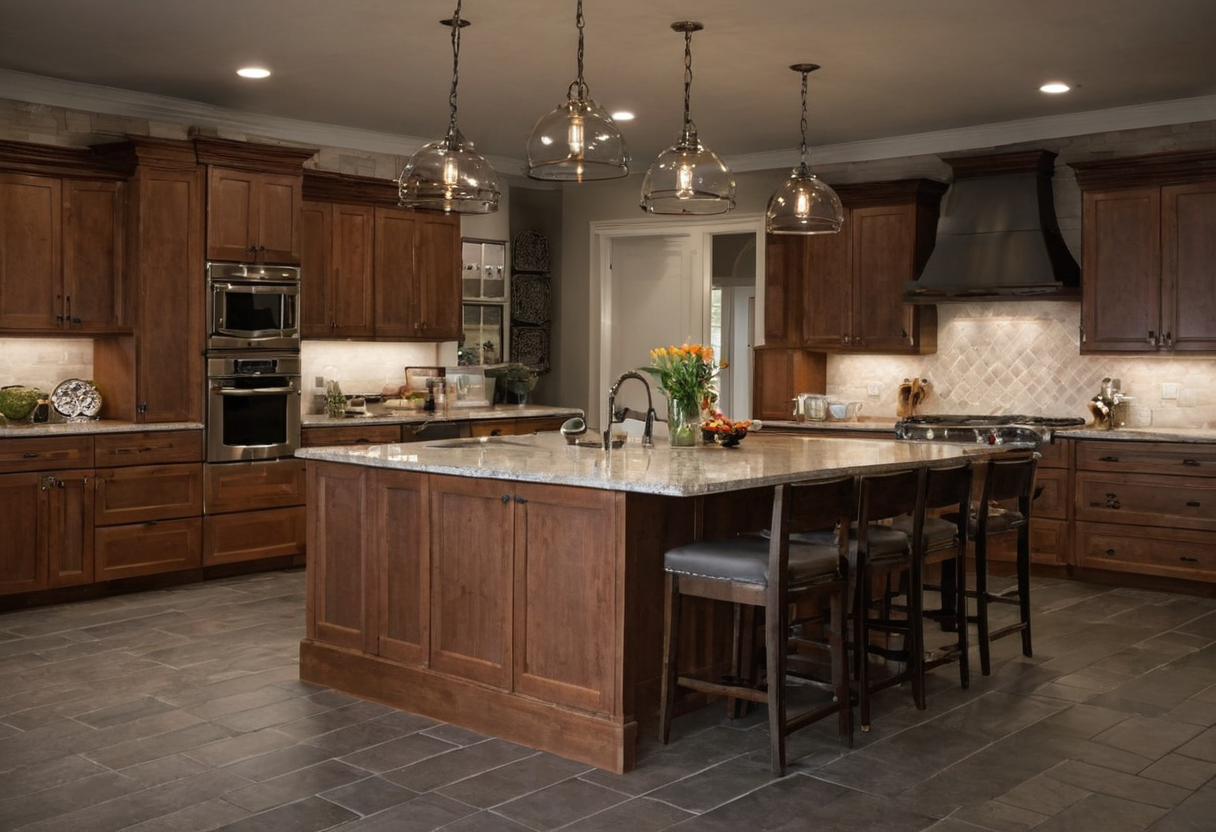
Why do CRI and R9 values matter more than CCT for kitchen island hanging lights.
CCT tells you whether the light appears warm or cool. The Color Rendering Index tells you how accurately that light reveals surface colors. Over absolute black granite or dark quartzite, the stone already absorbs most delivered lumens. A low-CRI LED strips away additional spectral information, flattening contrast between the counter and any object resting on it. Lighting manufacturers targeting food preparation areas specify CRI 90 as the baseline because lower ratings fail to separate ingredients visually from a dark work plane.
The CIE TM-30-18 standard expands this measurement with two metrics: fidelity index (Rf) and gamut index (Rg). Fidelity measures how closely a light source matches a reference illuminant. Gamut measures saturation shift. For kitchen tasks over dark stone, an Rf above 90 prevents hue distortion, while an Rg near 100 keeps natural food colors from appearing oversaturated or washed out. Selecting a fixture based solely on CCT misses these spectral gaps entirely.
Testing pendant fixtures under real conditions introduces another variable. Stone sealers applied to soapstone or quartzite off-gas after installation. The U.S. Environmental Protection Agency identifies paints, varnishes, waxes, cleaning products, building materials, and furnishings as common indoor sources of volatile organic compounds (EPA VOC sources). When running test pendants over freshly sealed slabs to evaluate CRI performance, the U.S. Environmental Protection Agency recommends increasing ventilation when using products that emit volatile organic compounds indoors (EPA ventilation guidance). Haze from curing sealer scatters light and corrupts spectrometer readings if the room remains closed.
This failure can trigger jobsite callbacks. Installers deliver the requested lumen output and the specified 3000K temperature, yet the homeowner sees a dull prep surface. The problem is not brightness or warmth. The missing red spectrum destroys task visibility exactly where precision matters. Once CRI and R9 thresholds are set, the next step is to match those spectral specifications to exact CCT and physical configurations for pendant light fixtures for kitchen island layouts.
Which CCT and specification combinations work for pendant light fixtures for kitchen island layouts?
This comparison table matches specific dark stone materials with the optimal CCT, minimum CRI, and R9 targets for pendant light fixtures for kitchen island installations. Selections assume a standard 30-inch mounting height above the counter and comply with North American residential electrical standards.
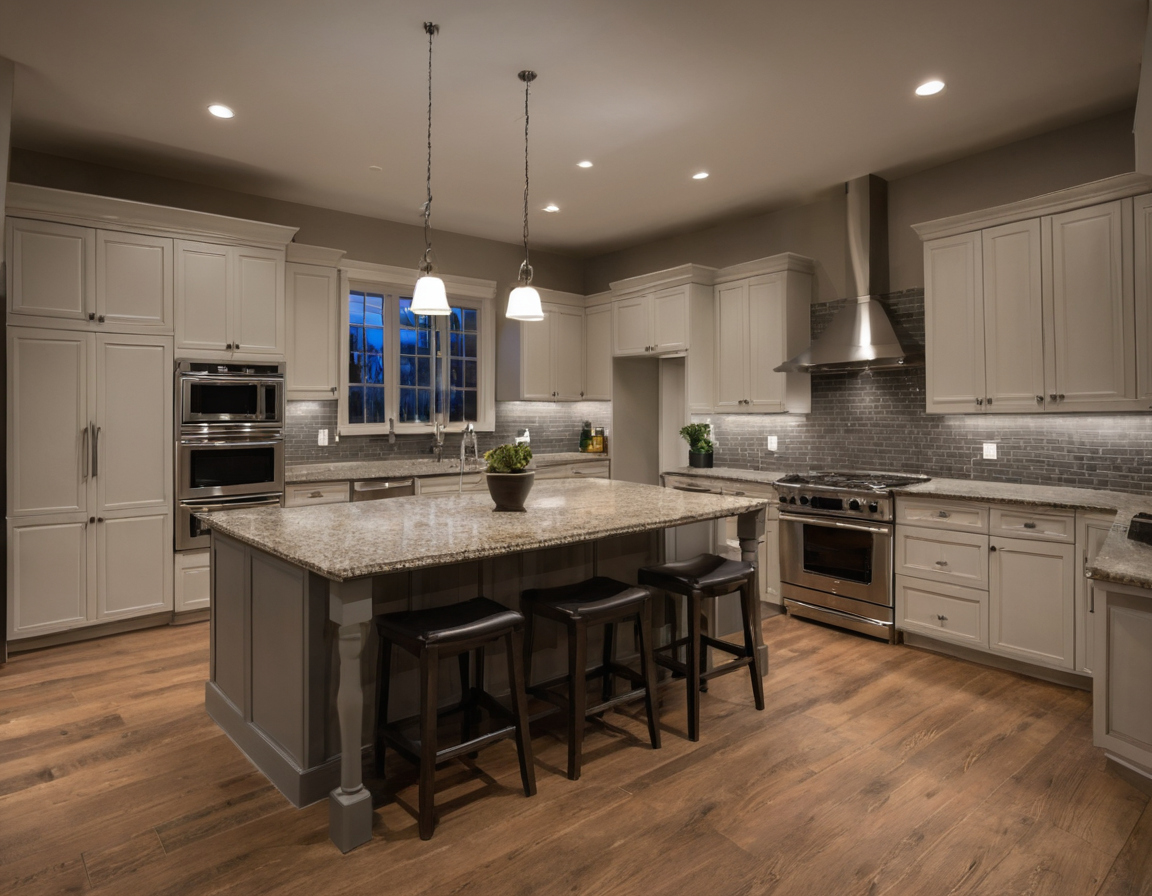
Which CCT and specification combinations work for pendant light fixtures for kitchen island layouts.
| Stone Material | Target CCT | Minimum CRI | Minimum R9 | Beam Angle |
|---|---|---|---|---|
| Absolute Black Granite | 3000K | 90 | 50 | 40 to 60 degrees |
| Soapstone | 3000K | 90 | 60 | 40 to 60 degrees |
| Dark Quartzite | 3000K to 3500K | 90 | 50 | 35 to 50 degrees |
Absolute black granite absorbs nearly all incident light, requiring a strict 3000K source with an R9 above 50 to prevent the surface from reading as a flat void. Soapstone carries subtle green or gray undertones that demand an R9 closer to 60 to keep warm mineral veining visible under task illumination. Dark quartzite often contains reflective crystalline structures, allowing a slightly wider CCT range between 3000K and 3500K without losing depth.
Mounting height determines delivered lux on the work plane. Position kitchen island hanging lights 30 to 36 inches above the finished counter surface. A 30-inch clearance concentrates the beam for prep tasks, while 36 inches spreads the pool across a wider dining zone. Coordinate these heights with the physical layout rules in our pendant sizing and spacing guide to avoid overlapping hot spots on low-reflectance stone.
Beam angle controls glare at seated eye level. Specify LED modules with a 40-degree to 60-degree distribution for absolute black granite and soapstone to cover the task area without spilling harsh light into the sightlines of seated users. Narrower 35-degree optics suit dark quartzite islands where focused downlight highlights natural crystal movement.
How do you verify color temperature before installing kitchen pendant lighting?
For more on this topic, see other guides on this site.