The fabrication of bespoke furnishings represents only a fraction of the project lifecycle in high-end residential and commercial fit-outs. Successful execution requires a rigorous project management framework encompassing engineering, material validation, logistics, and site integration. For developers and private clients managing complex requirements, such as those found in luxury interior design Qatar, the critical path extends significantly beyond the joinery workshop. This article analyzes the mandatory phases—engineering, procurement, logistics, and installation—that define a successful custom furniture contract.
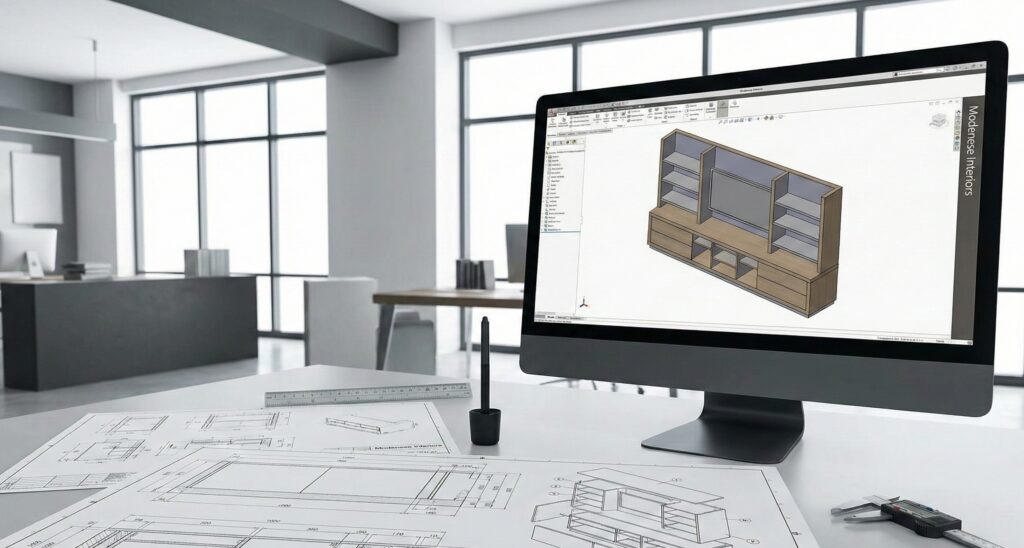
1. Technical Engineering and Shop Drawings
Before wood is cut or metal is cast, the design intent must be translated into manufacturing-ready instructions. This phase mitigates risk by resolving spatial conflicts and material incompatibilities.
Drafting and CAD Development
Manufacturers like Modenese Interiors employ dedicated technical departments to produce detailed shop drawings. These documents serve as the contract between the client and the factory. Key components include:
- General Assembly Drawings: Elevations and plans showing overall dimensions (millimeters) and spatial relationships.
- Exploded Views: Detailed diagrams indicating joinery methods (dovetail, mortise-and-tenon) and hardware locations.
- Sectional Details: Full-scale (1:1) profiles of moldings, structural reinforcements, and integrated lighting channels.
According to the Architectural Woodwork Institute (AWI), accurate shop drawings reduce installation errors by approximately 30% by identifying site-dimension discrepancies prior to production.
2. Material Procurement and Sample Approval (Control Samples)
The procurement phase ensures that the physical materials match the approved design specifications. This involves a multi-stage approval process known as “control sampling.”
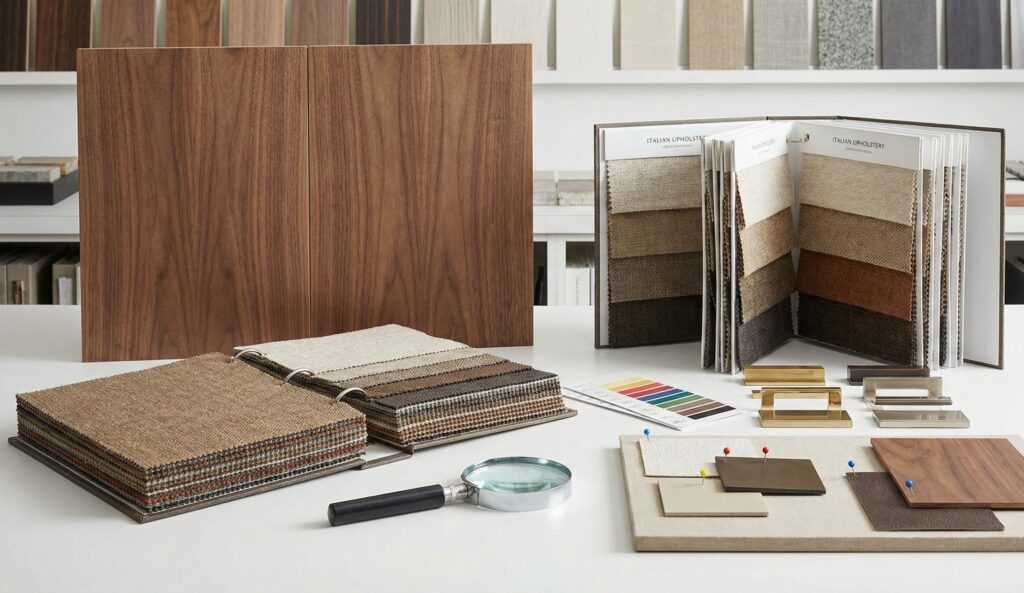
Textile and Veneer Selection
Consistency in natural materials is technically challenging due to variations in batch production. The approval process requires a physical sign-off on:
- Veneer Flitches: Reviewing entire log runs to ensure consistent grain matching (book-match, slip-match) across adjacent furniture pieces.
- Upholstery: Verifying dye lots for italian fabrics to prevent color shifting between production runs.
- Hardware Finishes: Testing galvanic plating thickness (measured in microns) for durability against corrosion, particularly for coastal installations.
3. Project Milestones and Time Allocation
A custom furniture project follows a rigid critical path. The following table outlines standard duration estimates for a high-complexity bespoke order.
| Site surveys, CAD production, client revisions, and final sign-off. | Key Activities | Estimated Duration |
|---|---|---|
| Technical Design | Site surveys, CAD production, client revisions, final sign-off. | 4–6 Weeks |
| Sampling | Material sourcing, finish application, shipping samples for approval. | 3–5 Weeks |
| Production | Millwork, assembly, upholstery, QC inspection. | 10–14 Weeks |
| Logistics | Crating, customs clearance, sea/air freight. | 4–8 Weeks (Location Dependent) |
| Installation | Unpacking, assembly, scribing, final leveling. | 1–3 Weeks |
4. Logistics and Export Compliance
Shipping high-value furniture requires specialized packaging and adherence to international trade regulations. Standard shipping methods are insufficient for bespoke millwork and delicate finishes.
Crating specifications
Goods must be packed in wood crates that comply with ISPM 15 standards (International Standards for Phytosanitary Measures), which mandate heat treatment to prevent the migration of pests. Inside the crate, packaging includes:
- Vibration Control: Shock-absorbing foam (Ethafoam) densities calculated based on item weight.
- Humidity Management: Silica gel desiccants are used to maintain a relative humidity level between 40% and 60% during transit, preventing wood warping.
- Tilt Sensors: Devices such as “Tip-N-Tell” indicators are attached to crates to record if cargo was mishandled or stored vertically against instructions.
Information regarding international shipping standards can be verified through the U.S. Customs and Border Protection or equivalent local authorities.
5. White-Glove Installation and Site Integration
The final phase is the on-site assembly. This is distinct from standard delivery; it involves skilled technicians who often travel from the manufacturing origin to the site.
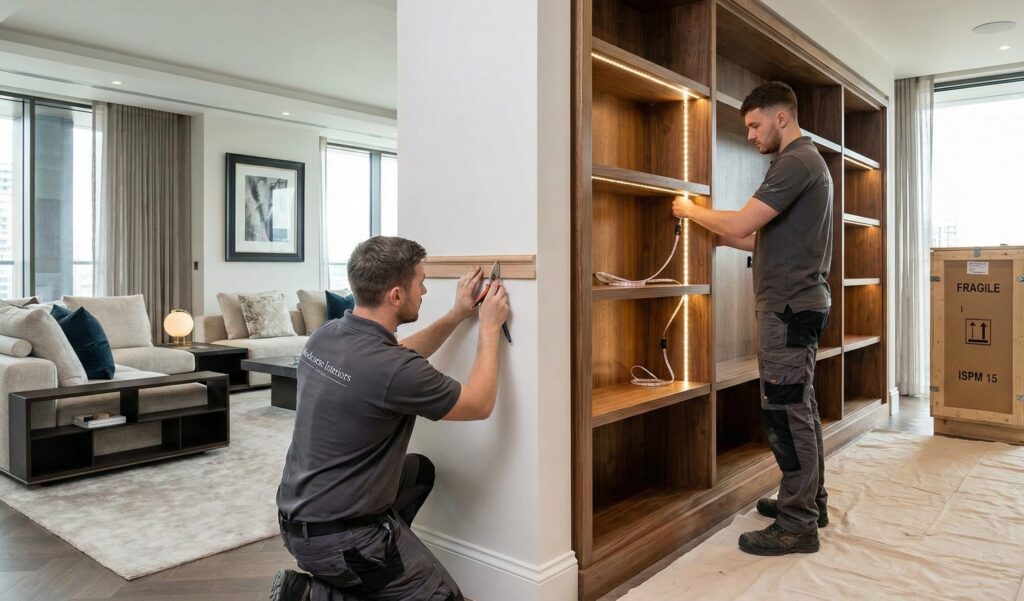
Site Readiness and Assembly
Before installation begins, the site must meet specific environmental criteria. The HVAC system should be operational for at least 72 hours prior to delivery to allow the space to acclimate. Technicians from companies like Modenese Interiors execute the following:
- Scribing: Cutting filler strips and moldings to fit irregular wall surfaces, ensuring a gap-free interface between furniture and architecture.
- Electrical Integration: Connecting pre-wired LED drivers in cabinetry to the main site power supply, requiring coordination with local electricians.
- Punch List Resolution: A formal inspection (walkthrough) to identify minor defects (scratches, misalignments) for immediate rectification using on-site touch-up kits.
Proper execution of these post-manufacturing phases determines the longevity and aesthetic integrity of the investment. For further reading on industry standards for installation, refer to the National Kitchen & Bath Association (NKBA) guidelines.